Skip to content

Narrow screen resolution Wide screen resolution Auto adjust screen size Increase font size Decrease font size Default font size default color brick color green color
You are here:Home
Plains Spadefoot Toad - Scaphiopus bombifrons PDF Print E-mail

By: This e-mail address is being protected from spam bots, you need JavaScript enabled to view it

Status

No status assigned in Iowa.

Description

Plains Spadefoot Toad -  Scaphiopus bombifrons
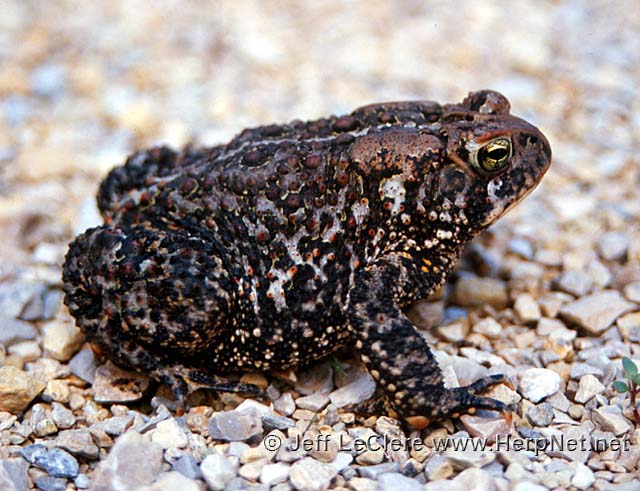
Plains Spadefoot, Scaphiopus bombifrons, from Fremont County, Iowa
 

Plains spadefoots are very unique Iowa amphibians. They are about 2 inches long. They have rather smooth moist skin that is brown or gray. On light specimens there is usually some dark pattern on the top, but not dark blotches that contain large warts. On dark specimens, the light area may be reduced to mottling or stripes. There are often some small red or orange spots present on the back. The body shape is the same as a toad's. Spadefoots get their name from the black spade-like projection on each back foot. There is a raised bump called a boss between the eyes. Spadefoots are the only amphibians in Iowa that have vertically elliptical pupils.

Subspecies

There are no subspecies of the plains spadefoot, Spea bombifrons.

Range

Spadefoots have been documented in every western border county in Iowa except Sioux and Lyon (Christiansen and Bailey 1991). Studies are being performed to define their range east of the loess hills (Farrar and Hey, 1998).

County Records for the Spadefoot Toad in Iowa
 

Habitat

Spadefoots are associated with the Missouri Alluvial Plain and the loess hills. Specimens have been found high in the hills (Christiansen and Mabry 1982) and also in the Missouri River floodplain (Farrar and Hey 1998, LeClere pers obs). They require ephemeral pools that remain for about a month after the eggs are laid. They live in open prairie areas outside of the breeding season.

Habits

Plains spadefoot " toads", as they are often referred to because of their toad-like shape, are active from May to mid September. They are not often seen above ground except at night after warm, heavy rains and on warm humid nights. I have found specimens active on the road in Fremont County on June 2. It was not a warm night but the humidity was high. They spend nearly all their time burrowed deep in the ground. They burrow with the aid of a dark colored "spade" on their back feet.

Spadefoots breed May through July and are referred to as "explosive breeders" by Johnson (1992). They usually breed during or immediately following warm, heavy rainstorms when depressions, farm fields, and small wetlands fill with water. The males give a quack-like call that lasts only one second. Females lay up to 2,000 eggs in masses of 10 to 250 (Collins 1982). Tadpoles hatch in one or two days (Johnson 1992). Because most breeding sites are flooded farm fields or depressions that dry quickly, the tadpoles metamorph in about a month.

The plains spadefoot toad was first recorded in Iowa in 1967 by Huggins (1971). Since then, they have been documented in nearly every border county in western Iowa and are thought to be increasing in abundance (Christiansen, 1981). Apparently, based on the Iowa Department of Natural Resources frog and toad surveys, Farrar and Hey (1998) felt that the species was declining in abundance. This was also supported by their two year survey of the distribution of these anurans in Iowa. They listed possible reasons why the frog and toad surveys were not picking up the numbers of spadefoots reported by Christiansen and Mabry (1982), all of which are plausible and the combination of these reasons could cause such a result. I believe the two most important reasons are: volunteers are not listening during the times of peak breeding activity and that volunteers are not monitoring the flooded fields or other pools. Although good for spadefoots, these sites may not be suitable for other breeding anurans and are overlooked by surveyors. More studies and sampling of spadefoots east of the loess hills may provide answers.

Food

Adult spadefoots eat small invertebrates. Polymorphic tadpoles have been recorded by Farrar and Hey (1998) as well as cannibalistic tadpoles. The omnivorous form is the most common tadpole form. Those that prey upon fairy shrimp are the carnivorous form. The rare cannibalistic form has a stronger serrated beak, and of course, develops faster than the others.

 
< Prev   Next >

Bookmark Us


Google
- - - - - - -

Who's Online

We have 11 guests online